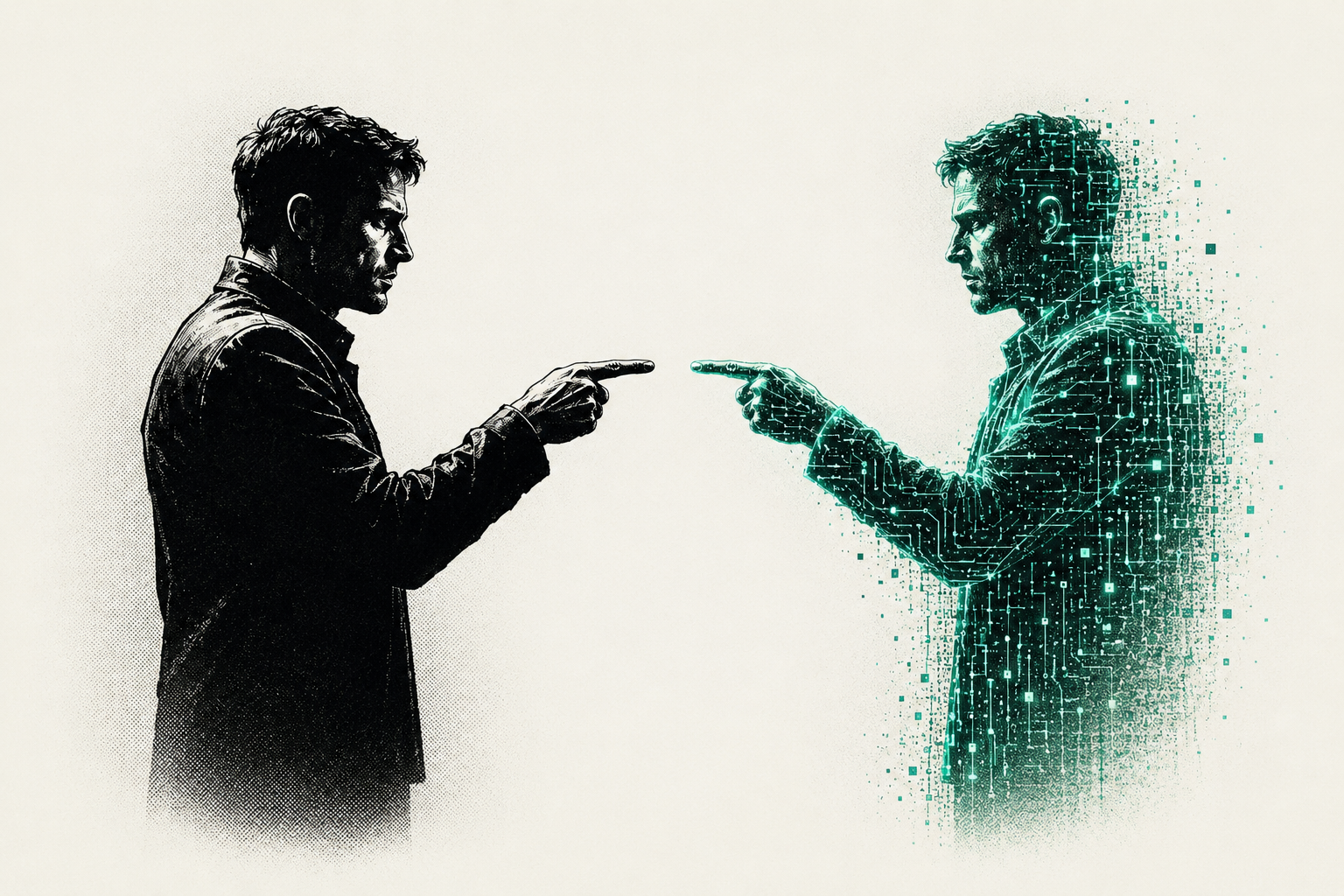
The deal is for a post. The asset is your face.
A brand reaches out. They like your videos, they want one for their product, and they will pay you for it. The fee is for the post. What you may also be signing over, in the agreement or in the platform's terms sitting behind it, is the more valuable thing: a licence to your likeness. Your face, your voice, the way you move and talk, to use again, to pass to other companies, and increasingly to feed into a system that can generate you.
Most creators never read that far. The money is for the video, and the video is the job. But the video is not the asset. You are.
What "we may use your likeness" turned into
For years a likeness clause meant a company could keep running your photo in an ad, or use your video a little longer than you meant. Annoying, finite, survivable. AI changed what the same sentence permits. A licence to "use your name, image and likeness" can now reach as far as a synthetic version of you: an avatar that says new lines, in new ads, for new clients, months after the shoot, without anyone calling you back.
This already happens to people who signed up for precisely that and still lost control. An actor sold his likeness to an AI-avatar company in its early days, on the assurance it would never be used for anything nefarious. He later found his face fronting propaganda videos for an authoritarian state. A journalistic investigation documented the same company's avatars being used by governments to read out fake news. He had given consent. He had not given consent to that, and once the avatar existed, where it travelled was no longer his to decide.
Promotion is one permission. A synthetic you is another.
Here is the distinction the fine print is built to blur. Letting a brand use your likeness in promotion is not the same as letting it train an AI on you, or generate a double of you. They are separate permissions, and a broad "all media, in perpetuity" grant is written to swallow the second without ever naming it.
The people whose whole livelihood is their likeness saw this coming and fought for a fence around it. The screen actors' union, SAG-AFTRA, now demands clear, specific, written consent and extra pay before a performer's digital replica can be made or used at all. A creator uploading to a brand's content portal has none of that. Their default is the older one: broad rights, long terms, and until very recently a norm that let a brand keep your content more or less forever. The reason agencies are suddenly racing to write an "AI clause" is that the clause already there gave away more than anyone intended.
It is not only creators
This is the part that lands even if you have never taken a brand deal in your life. You do not have to be paid for your face to grant this licence. You agree to a version of it every time you upload a photo to a platform and tap accept.
The sharpest example is the one where the file is most personal. A dating or matrimony profile is assembled from exactly what a model is hungry for: clear, well-lit, self-labelled photographs of your face, tied to your real name, your age, your location, often a verification selfie. Read the terms on a lot of these services and the same broad, transferable licence over everything you post turns up, the one that outlives your account. The creator simply sees the consequence first, because their face is the product on the shelf. For everyone else the identical sentence sits in the terms, quiet, with the identical effect.
You cannot pull a face back out of a model
One thing sets this apart from an ordinary overreach. If your likeness has been used to train a model, deletion cannot fully reach it. You can close the account and remove the photos. What the model learned from your face, it keeps. Europe's data regulators said as much at the end of 2024: a model trained on personal data is not automatically anonymous, and where that data was taken unlawfully, the model built on it can answer for it too. It is the same wall we ran into with "anonymised" data and with the copies you can never recall. Your face is only the most personal version of it.
What moves in your favour is that the law is starting to treat your likeness as plainly yours. A federal bill, the NO FAKES Act, would make it unlawful to generate an AI replica of someone's voice or face without consent. Tennessee already has its own version in force. Denmark has moved to rewrite its copyright law so that every person "has the right to their own body, voice and facial features," with the standing to demand takedowns. None of that un-trains a model that already learned you. All of it points the way the "anonymised" standard is moving: the bar is rising, and a use that felt harmless the day you agreed to it may not read that way later.
What to actually do
You cannot take back the video or the photo, and you cannot chase a stranger who may have cloned your content into some model. What you can do is act on the company you actually dealt with: the brand that paid you, the agency that signed you, the platform you handed your face to. Each is a named holder of your likeness, and each can be asked.
- Before you sign or upload, read for the two words that now carry the weight: "licence" and "likeness." If a deal wants perpetual or AI rights to your face, that is a separate thing to be paid for, or to refuse.
- For a company that already holds your likeness, ask it plainly, in writing, to confirm whether your image or content has been used to train or generate AI, to delete your personal data including your likeness, and to stop using it for any further AI training or generation. You do not have to prove anything or argue the law. You need the answer in writing.
- Keep whatever comes back. If your face later surfaces where it should not, a dated reply about what they did, or did not, do with it is the only evidence you will have.
That is the whole move, and it is the part the system counts on you skipping. You search for the company, add it, and the request to confirm, delete and object is drafted for you to send. What it writes back lands in your own inbox, dated, which is where the proof belongs. You may not be able to make a model forget your face, but you can be the one who asked, on the record, before it spread further. Start your record →