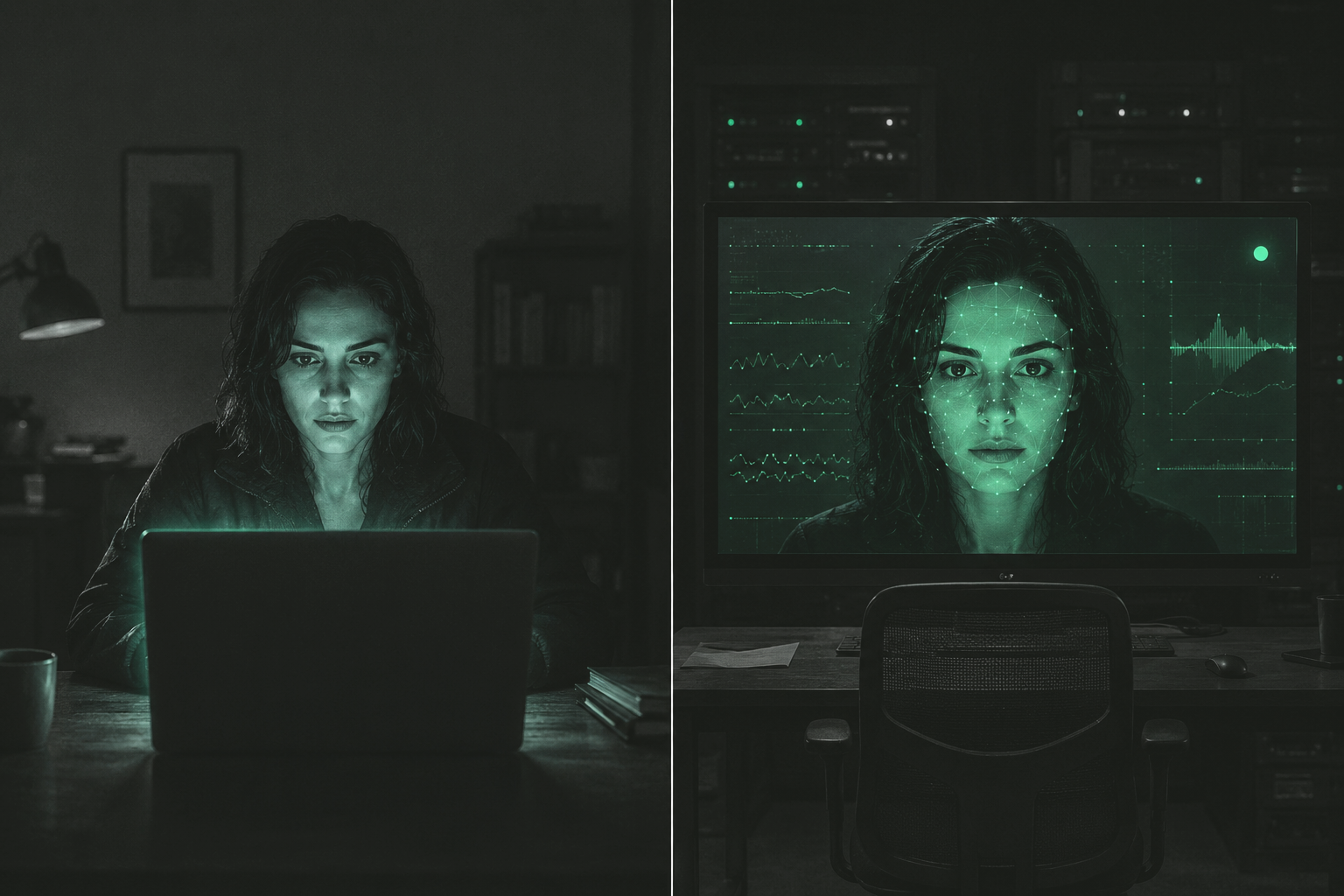
Before anyone interviews you
Here is one way it goes now. You apply. Before you meet anyone who could actually hire you, a recruitment agency wants a screening call, "just to get to know you." It will be a video call, and it will be recorded. Before the call, could you send a photo of your ID? By email is fine.
Stop and count what has been collected before a single interview question is asked. A government identity document, with your face, date of birth, address and document numbers, now sitting in an inbox. A recording of your face and voice, your accent, your home in the background, and the way you hold yourself when something matters. Your CV, which already lists most of your life. You have not been interviewed. You have been collected.
That is one door. It is not the only one. Some companies skip the agency and send you straight to the software: an interview with no human on the other end, where the recording is scored and the score decides whether a person ever sees you at all. Others do not interview first, they assess: an exercise, a test, a questionnaire, scored by software you never see. These are not stages of one process. They are parallel routes, run by different companies, and every one of them collects before it decides.
And running under every route is the same ending, because most applications finish the same way: in silence. No reply, or a vague line that answers nothing, and no one to ask. The process collects on the way in and goes quiet on the way out.
Where the recording goes
Take the recorded screening first. Read the privacy policy behind one, if you can find it, and the quiet clauses are usually there: the recording may be used for internal training, and it may be shared with clients and recruiters. Which means the video of you performing for a job can be shown to people you have never met, at companies whose names you have not been told, before any interview has happened.
You do not have to take our word that this happens. In the United States, Illinois wrote a law specifically about candidate videos: employers must get written consent before AI analyses an interview recording, may not share the video beyond the people whose expertise is needed to evaluate the candidate, and must delete it, and every copy anyone else holds, within thirty days of the candidate asking. Legislatures do not write clauses like that about things that are not happening.
And when the UK regulator audited the AI tools used in recruitment, it came back with nearly three hundred recommendations. It found tools collecting far more than they needed and keeping it indefinitely, building databases of candidates without their knowledge. It found tools that inferred gender and ethnicity from little more than a name, and tools that let recruiters filter candidates by protected characteristics. It found vendors taking the data candidates handed over for a job application and reusing it to train their own AI products. Your screening is their raw material.
The machine that scores you
The software interview deserves its own daylight, because of what it admits about the data.
One of the largest video-interview platforms spent years scoring candidates partly on their facial expressions, between a tenth and a third of the score, while claiming to measure "cognitive ability," "psychological traits" and "emotional intelligence" from a recording. After a complaint to the US trade regulator, it dropped the facial analysis, with its own research reportedly showing the faces had contributed almost nothing to the predictions. The analysis of voice, wording and behaviour stayed.
Think about what an interview recording is. You, under real pressure, with something at stake, trying to be impressive for a stranger. There are few richer samples of a person. That is exactly why the software wants it, and exactly why you should care where it goes. And the people who go through these software interviews describe the same ending again and again: rejected by something, no reason given, no one to ask, and a recording of their most pressured half hour left behind with a company they will never hear from again.
The exercises and tests run on the same terms. Whether it is a timed task, a set of puzzles or a personality questionnaire, your answers, your timings and your choices are logged and scored into a result that arrives with no reasons attached, if it arrives at all.
Every so often, the inside of that black box comes into view, and it looks like what the candidates suspected. A tutoring company's application software was set to automatically reject women over 55 and men over 60, and the only reason anyone found out is that one applicant sent two identical applications with different birth dates and only the younger one got an interview. More than two hundred people had been binned by a rule, each of them presumably wondering what they had done wrong. And a man over forty who was rejected by every one of the more than one hundred jobs he applied for through one major screening platform took it to court; a judge has now let the case proceed for millions of over-forty applicants screened through the same software. Notice what it took to see inside, both times: an accidental experiment and a lawsuit. Everyone else just gets the silence.
One more layer sits under the real processes: the fake ones. Job scams are one of the fastest-growing frauds going, with reported losses rising from ninety million dollars in 2020 to over five hundred million in 2024, and the US consumer regulator's warning is blunt: for some "employers," your documents are the whole point, and the sensitive information might be the focus of your "interview." A listing that looks too good, moves too fast, and wants your ID before it wants your skills is often not a job at all. It is a scam built to collect your documents.
The hiring machine, in numbers
None of these numbers were volunteered. They were audited, sued, or subpoenaed out.
Why the heaviest asks sit here
Notice where all of this is positioned. Not at a checkout, where you can abandon the basket. Not at a sign-up, where you can close the tab. At the door to your income, at the exact moment refusing feels like it costs you the job.
That is the imbalance doing the work. A job seeker cannot negotiate. Decline the emailed ID, question the recorded screening, ask who sees the video, and you are the difficult candidate in a stack of easier ones. Every demand lands on someone who has strong reasons to say yes and almost no power to say no. The demands sit where refusal costs the most, and they grow because they can.
What you can do without losing the job
Being realistic is the point, so none of this requires you to be difficult. It requires you to keep records.
Ask the one plain question. Before a recorded screening, one short email: what will the recording be used for, who will see it, and how long is it kept? It is a reasonable question asked politely, it takes them a minute, and whatever comes back is a dated answer in your inbox. Silence is an answer too.
Log the handover the moment it happens. The agency, the platform, the verification company behind it, the one you never chose. Not because logging protects the data, but because in three months you will not remember who has your passport, and the company counting on that forgetting is holding it.
When the process ends, either way, send the requests. Ask what they still hold. Ask them to delete what they can, and to tell you what they keep and until when. Tell them to stop using your data for anything beyond the hiring you applied for, which covers the training sets and the candidate databases. And if software scored you and you never got a reason, you can ask them to explain the decision and to have a human look at it. That is not cheek. In much of the world it is a legal right.
And if the process never ends, because they simply stopped answering: being ghosted does not mean your file went away. The CV, the ID, the recording sit in their systems whether or not anyone replied to you. A deletion request has a legal clock on it, a month in the UK and Europe, so the company that never answered your application has to answer this: delete what you sent, or name what they keep and why. And if you suspect software binned you before a person ever looked, ask the direct question, which the same law lets you ask: was my application decided by automated means, and on what logic? None of this gets you the job. It gets you the truth about what happened to your file, and it takes that file out of the pile on your way past.
And before any of it, if the listing feels too good: check the company exists and is actually hiring before your ID leaves your hands. The document that proves who you are is the one thing in this whole process that cannot be reissued casually once it is loose.
Start the record
The moment you email your ID to a recruiter is precisely the moment worth writing down. DÆTRAX is where that record lives: log the agency, the platform and the verifier, send the requests in plain English from your own inbox, and let every answer, claim and silence land against a date. You cannot make the process fair from your side of it. You can make sure that, for once, the candidate kept the file. Start your record →